

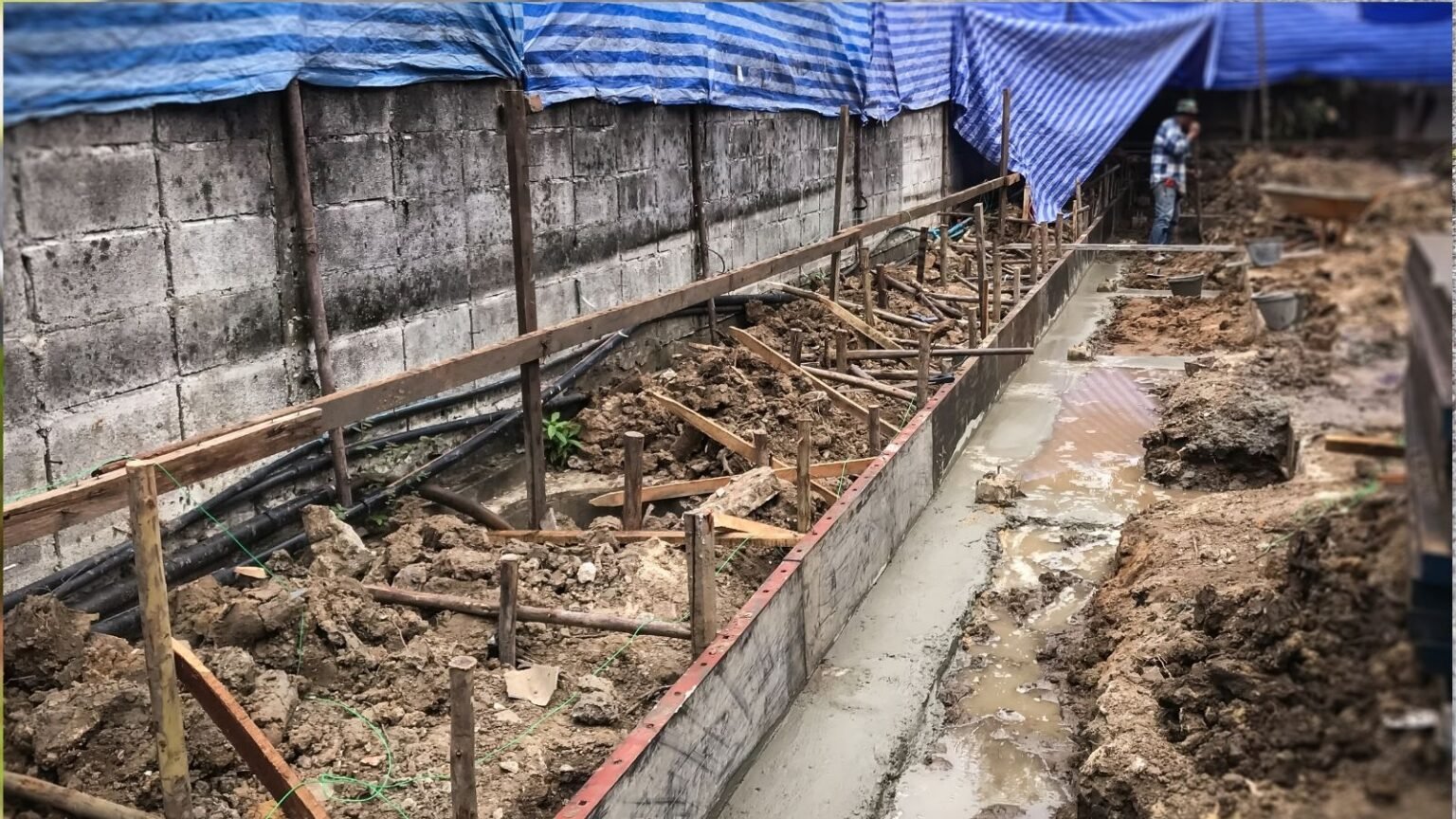
Foundation settling is the gradual downward movement of a home’s foundation as the soil beneath it compresses over time. Minor settling of 1–2 inches over decades is normal. Differential settlement—where different parts of the foundation sink unevenly—is the type most likely to cause structural damage and require professional foundation repair.
Every house settles. That’s not a warning—it’s simply physics. As a newly built home transfers its load onto the soil beneath it, the ground compresses slightly and the foundation shifts into its long-term position. For most homeowners, this process is gradual, minor, and entirely unremarkable.
The problem is that not all foundation settling is benign. Some forms progress slowly into serious structural damage. Others can develop quickly due to poor soil conditions, drainage failures, or vegetation encroachment. And once a foundation begins to fail in earnest, the repair costs can climb fast—often into the tens of thousands of dollars.
Knowing the difference between normal house settling and dangerous foundation settlement is one of the most valuable things a homeowner can understand. Catch the warning signs early and you might spend a few thousand dollars on a targeted fix. Miss them, and you could be facing foundation failure, compromised structural integrity, and a significantly reduced home value.
This guide covers everything you need to know: what causes foundation settling, how to identify the six types of settlement, which warning signs demand immediate action, and what your repair options actually look like—including realistic cost estimates. If you’re buying a home, currently experiencing cracking or shifting, or just want to protect your investment, this is the resource to bookmark.
What Is Foundation Settling, and Why Does Every House Do It?
Foundation settling refers to the downward movement of a home’s foundation as the soil beneath it adjusts to the structural load placed on it. When a house is built, the weight of the structure—walls, roof, floors, contents—transfers through the foundation into the ground. That ground, no matter how well it was prepared, will compress to some degree.
This compression is a normal part of any building’s lifespan. Most residential foundations experience some degree of settling in their first few years, and minor movement can continue for decades without causing any structural concern.
The distinction homeowners need to make is between uniform settlement, where the entire foundation sinks at a similar rate, and differential settlement, where different sections move at different rates or in different directions. Uniform settlement is generally manageable. Differential settlement is where structural damage begins.
Normal Foundation Settling vs. Serious Foundation Settlement
Normal settling typically involves minor, gradual, and uniform movement—often less than 1 inch over the life of the structure. Hairline cracks in drywall or minor sticking of doors during seasonal humidity changes are common byproducts of this kind of movement and are not inherently alarming.
Serious foundation settlement looks different. The signs include:
- Cracks wider than ¼ inch, especially those that are diagonal or stair-stepped
- Uneven or sloping floors that are measurably out of level
- Doors and windows that no longer close properly regardless of season
- Foundation cracks with displacement—where one side of a crack is higher than the other
- Rapid progression of any crack or shift over weeks or months
The U.S. Army Corps of Engineers uses a differential settlement threshold of 1/300 of the span between two points as a benchmark for when cracking becomes likely in rigid structures. For a 30-foot span, that’s roughly 1.2 inches of differential movement. Beyond that threshold, structural damage becomes increasingly probable.
What Causes a House to Settle?
Foundation settling has many causes, and they often work in combination. Understanding the root cause is essential before choosing a repair strategy.
Natural Settlement
All soil compresses under load. The rate and extent of compression depend on soil density, moisture content, and composition. New construction tends to settle more noticeably in the first 3–5 years as the soil reaches equilibrium with the structural load.
Poorly Compacted Soil
When builders fail to adequately compact the soil during site preparation, voids remain beneath the foundation. Over time, those voids collapse—sometimes unevenly—causing differential settlement. This is a construction-phase problem with long-term consequences.
Soil Type: Clay, Sandy, and Loamy Soils
Soil composition is one of the biggest variables in foundation performance:
- Clay soils shrink when dry and expand when wet, creating cyclical movement that can crack and shift foundations over time. Expansive clay soils are responsible for a significant portion of foundation damage in the United States.
- Sandy soils drain quickly and don’t expand, but they can erode or shift under load, particularly in the presence of water movement.
- Loamy soils tend to be the most stable for construction, offering balanced drainage and moderate compressibility.
Homeowners in regions with high clay content—much of Texas, Oklahoma, and the southeastern United States—face elevated foundation settlement risk compared to those in sandy or loamy soil regions.
Drying Soil
Extended drought causes soil to dry out, contract, and pull away from the foundation. When this happens across an uneven footprint, differential settlement follows. Homes built during wet periods and then subjected to prolonged drought are particularly vulnerable.
Frost Heave
In cold climates, water in the soil freezes and expands, pushing the foundation upward. When that ice thaws, the foundation settles back down—sometimes unevenly. Repeated freeze-thaw cycles gradually destabilize the foundation’s bearing surface.
Vegetation and Tree Roots
Large trees near a home draw significant amounts of moisture from the soil. In clay-heavy soils, this moisture extraction causes the ground to contract near the tree’s root zone, creating localized settlement. Tree roots can also physically intrude beneath footings and displace soil over time.
Seismic Vibrations
Earthquakes, as well as sustained vibrations from nearby construction, heavy traffic, or industrial equipment, can loosen or shift soil beneath a foundation. Even minor seismic events can initiate or accelerate differential settlement in susceptible soil types.
Sinkholes
Sinkholes form when underground material—often limestone or other soluble rock—dissolves due to groundwater movement, leaving a void that eventually collapses. Foundation settlement caused by sinkhole activity tends to be sudden and severe, requiring immediate professional assessment.
Types of Foundation Settlement
Not all settlement behaves the same way. Engineers categorize foundation settlement into distinct types based on how and why it occurs.
Immediate Settlement
Immediate settlement occurs within hours or days of a load being applied to the soil. It happens as air and water are expelled from soil pores under pressure. Sandy soils are particularly prone to immediate settlement. While this type typically stabilizes quickly, it can cause damage if the rate is uneven.
Consolidation Settlement
Consolidation settlement develops slowly over months or years as fine-grained soils—particularly clay—gradually expel water under sustained load. This is one of the most common causes of long-term differential settlement in residential construction.
Creep Settlement
Creep is the slow, continuous deformation of soil under constant load, even when there is no change in moisture or external conditions. Clay and organic soils are most susceptible. Creep settlement can persist for decades and is difficult to arrest without addressing the underlying soil conditions.
Uniform Settlement
Uniform settlement occurs when the entire foundation sinks at the same rate and to the same depth. Provided the movement is small and stable, uniform settlement rarely causes structural damage to the building above. The foundation moves, but the structure moves with it.
Differential Settlement
Differential settlement is the most destructive type. When different parts of the foundation settle at different rates or to different depths, the structure above it is subjected to unequal forces. This produces the visible warning signs most homeowners associate with foundation problems: diagonal cracks at door and window corners, sloping floors, and out-of-square frames.
Curve Settlement
Curve settlement—sometimes called hogging or sagging—occurs when the center or edges of a foundation settle more than the opposite section, causing the foundation to bow or curve. This is particularly damaging to masonry and concrete structures, where tensile forces create cracking along the zone of maximum stress.
Warning Signs of Foundation Settling
Early detection is everything when it comes to foundation problems. These are the signs most likely to indicate that settling has moved beyond the normal range.
Hairline Cracks in the Foundation
Thin, hairline cracks in a poured concrete foundation are common and usually benign. They often result from concrete shrinkage during curing. On their own, hairline cracks (less than 1/16 inch wide) are generally cosmetic. Monitor them with a pencil mark and date to track whether they grow.
Wide or Uneven Foundation Cracks
Cracks wider than ¼ inch, or cracks where one side is displaced vertically from the other, indicate active structural movement. Horizontal cracks in basement walls are especially serious—they often signal lateral soil pressure that is compromising the wall’s structural integrity.
Stair-Step Cracks on Foundation Walls
Diagonal cracks that follow the mortar joints of brick or block foundations in a stair-step pattern are a hallmark of differential settlement. The crack follows the weakest path through the masonry, which typically runs diagonally when the foundation is twisting or sinking unevenly.
Sloping or Uneven Floors
A floor that feels bouncy, sloped, or noticeably unlevel is a significant indicator of foundation movement. A drop of more than 1 inch over 20 feet generally warrants professional evaluation. Place a level on multiple floor joists to determine whether the slope is consistent (often structural) or localized (sometimes a subfloor issue).
Doors and Windows Sticking
Doors and windows that stick, drag, or fail to latch properly are among the earliest functional signs of foundation settlement. When a foundation shifts, it distorts the door and window frames—rectangular openings become parallelograms. If sticking occurs consistently across multiple openings and seasonally adjusted humidity isn’t a factor, investigate further.
Nail Pops in Drywall
Nail or screw pops in drywall—where fasteners push through the surface finish—can signal framing movement caused by foundation settling. While occasional nail pops are normal in new construction, clusters of pops appearing across multiple rooms may point to a structural cause.
Cabinets Pulling Away From Walls
Kitchen or bathroom cabinets that develop visible gaps between their back panel and the wall are often responding to framing movement driven by foundation shifts. The gap is typically widest at one end of the cabinet run, revealing the direction of movement.
Drywall Cracks
Diagonal cracks at the corners of door and window openings are the most diagnostically useful drywall cracks. They form because the corner is a stress concentration point—when the framing above a foundation shifts, these corners are the first to crack. Long, diagonal cracks running across a wall face, or cracks that appear simultaneously on multiple levels of the home, are higher-priority concerns.
When Should You Worry About Foundation Settling?
The threshold between “monitor this” and “call a structural engineer” is not always obvious. As a practical guide:
Act immediately if you observe:
- Horizontal cracks in basement or crawl space walls
- Cracks with vertical displacement (one side higher than the other)
- A floor that has dropped noticeably in a specific area
- Multiple warning signs appearing at the same time or progressing rapidly
- Gaps between the foundation and framing or sill plate
Monitor closely but don’t panic if you observe:
- Hairline cracks that haven’t changed in months
- Minor seasonal sticking in one door or window
- Isolated nail pops in a newer home
Any crack or symptom that changes noticeably over 2–4 weeks warrants professional evaluation. A licensed structural engineer—not just a foundation repair contractor—provides the most unbiased assessment. For more guidance on structural home improvement decisions, explore the home improvement resources at Flight Homes.
How to Repair Foundation Settlement
Foundation repair is not a DIY category. The methods below are performed by licensed structural engineers and foundation repair contractors. The right approach depends on the type of settlement, soil conditions, foundation type, and severity of damage.
Push Piers
Push piers (also called resistance piers or steel piers) are driven deep into the soil beneath a settling foundation until they reach load-bearing bedrock or dense soil. Hydraulic jacks then transfer the foundation’s load to the piers and can, in many cases, lift the foundation back toward its original position. Push piers are one of the most reliable long-term solutions for differential settlement caused by weak or shifting soil.
Underpinning
Underpinning extends the foundation’s depth or base to reach more stable soil or rock. Traditional mass concrete underpinning involves excavating sections beneath the existing footing and filling them with new concrete in a staged sequence. Beam and base underpinning uses a reinforced concrete beam to transfer loads to new concrete bases. Underpinning is labor-intensive and disruptive but highly effective for severe or ongoing settlement.
Structural Repairs and Reinforcements
Once the foundation has been stabilized, the structural damage above it must be addressed. This includes repairing or replacing cracked foundation walls, re-leveling floor systems, reframing distorted door and window openings, and patching drywall. For more on structural repair and home improvement projects, the Flight Homes blog covers a wide range of related topics.
Foundation Drainage Systems
Many foundation problems are aggravated or initiated by poor water management. French drains, interior drainage channels, sump pump systems, and grading corrections direct water away from the foundation before it can saturate and destabilize the soil. Adding drainage is often a preventative measure, but it is also a critical companion repair for any foundation stabilization project.
How Much Does Foundation Repair Cost?
Foundation repair costs vary significantly based on the repair method, the severity of the problem, and regional labor rates. These are general ranges based on commonly reported industry pricing:
- Crack injection (epoxy or polyurethane): $250–$800 per crack
- Carbon fiber wall reinforcement: $350–$1,000 per strip
- Push piers or helical piers: $1,000–$3,500 per pier, with most projects requiring 4–12 piers
- Full underpinning: $10,000–$40,000+ depending on scope and foundation size
- Foundation drainage system installation: $5,000–$15,000
Minor repairs for cosmetic cracking may cost under $1,000. Major structural stabilization projects for significant differential settlement commonly run $15,000–$30,000 or more. According to HomeAdvisor, the national average cost of foundation repair sits around $4,500, but projects involving pier installation or underpinning routinely exceed this figure.
Getting at least three quotes from licensed contractors—and an independent assessment from a structural engineer—is strongly recommended before committing to any foundation repair project.
How to Prevent Foundation Settling
No foundation can be made completely immune to settling, but these practices meaningfully reduce the risk of serious problems:
Maintain consistent soil moisture. Dramatic swings between dry and saturated soil drive the most damaging cycles of shrinking and expansion. During dry periods, using a soaker hose to maintain modest soil moisture around the foundation perimeter helps stabilize clay soils.
Control drainage at the surface. The ground around your home should slope away from the foundation at a minimum grade of 6 inches over 10 feet. Clean gutters regularly, extend downspouts at least 4–6 feet from the foundation, and repair any low spots where water pools after rain.
Manage vegetation. Keep large trees and shrubs at a safe distance from the foundation. A mature oak with a 40-foot canopy can have a root zone extending 20 feet or more. Consult an arborist if you have large trees planted close to the home.
Monitor and respond early. Conduct a visual inspection of your foundation perimeter twice a year. Document cracks with photographs and measurements. Early detection keeps repair costs manageable.
Protect from frost. In cold climates, ensure foundation insulation is intact and that drainage prevents water from accumulating near the foundation before freeze events.
For homeowners navigating real estate decisions that involve homes with potential foundation concerns, understanding these warning signs before purchase can prevent costly surprises down the line.
Don’t Wait for a Crack to Become a Collapse
Foundation settling is one of those problems that rewards attentiveness and punishes delay. A stair-step crack noticed early and assessed by a structural engineer might cost a few hundred dollars to monitor and a few thousand to repair. The same crack, ignored for two or three years, can become a structural failure requiring a six-figure remediation.
The structural integrity of your home rests—quite literally—on what happens beneath it. Proactive soil moisture management, proper drainage, and regular visual inspections are the lowest-cost, highest-return investments a homeowner can make in their property’s long-term stability.
If you’re seeing multiple warning signs at once, or any single sign that is progressing rapidly, contact a licensed structural engineer. Don’t rely solely on a foundation repair contractor’s diagnosis—an independent engineering assessment gives you an unbiased picture of what you’re actually dealing with and what your options are. The American Society of Civil Engineers (ASCE) maintains a directory of licensed structural engineers by region at asce.org.
Frequently Asked Questions About Foundation Settling
What is the difference between foundation settling and foundation failure?
Foundation settling refers to normal, gradual downward movement of a foundation as soil beneath it compresses under load. Foundation failure occurs when settlement is excessive, uneven, or rapid enough to structurally compromise the home—causing significant cracking, distortion of load-bearing elements, or loss of structural integrity. Settling is expected; failure requires professional intervention.
How much foundation settling is considered normal?
Uniform settlement of less than 1 inch over the life of a home is generally considered normal and non-structural. Differential settlement exceeding approximately 1/300 of the span between two reference points—roughly 1 inch over 25 feet—is the threshold at which structural damage becomes likely.
Can foundation settling be fixed permanently?
Yes, in most cases. Push piers, helical piers, and underpinning transfer the foundation’s load to stable soil or bedrock, halting ongoing settlement. When paired with proper drainage improvements to address the root cause, these methods provide durable, long-term stabilization. No repair can guarantee zero future movement, but engineered solutions come with transferable warranties in most cases.
Is foundation settling covered by homeowner’s insurance?
Standard homeowner’s insurance policies typically exclude foundation settling and related damage, classifying it as a maintenance issue rather than a sudden, accidental event. Some policies cover foundation damage caused by specific perils such as plumbing leaks or sinkhole activity. Review your policy carefully and consult your insurer before assuming coverage.
How do I know if my foundation cracks are serious or cosmetic?
Hairline cracks (under 1/16 inch) that are stable over time are generally cosmetic. Cracks wider than ¼ inch, cracks with vertical displacement between the two sides, horizontal cracks in basement walls, or any crack that is actively growing are serious and warrant professional evaluation. Stair-step cracks in block or brick foundations are a reliable indicator of differential settlement.
Does foundation settling affect home resale value?
Active foundation problems can significantly reduce a home’s market value and complicate sale transactions. Repaired foundation issues—with documentation from a licensed engineer and a valid transferable warranty—typically have a much smaller impact on value. Disclosure requirements vary by state, but most require sellers to disclose known material defects including foundation problems.
How quickly does serious foundation settlement develop?
The timeline varies by cause. Settlement driven by soil consolidation in clay develops over months to years. Settlement caused by sinkhole activity, severe erosion, or plumbing leaks can occur rapidly—sometimes within days or weeks. Any symptoms that progress noticeably over a 2–4 week period should be evaluated by a structural engineer without delay.